
When Critical Controls Fail
On April 5, 2010, an explosion tore through the Upper Big Branch Mine-South near Montcoal, West Virginia. Twenty-nine miners were killed, and two others were injured.
The disaster was the deadliest U.S. coal-mine accident in nearly four decades. It was also preventable.
The Mine Safety and Health Administration found that the explosion was not caused by one isolated mistake. It resulted from multiple failures that aligned: methane control, equipment maintenance, water-spray performance, mine examinations, coal-dust cleanup, rock-dust application, and management oversight.
How the Explosion Developed
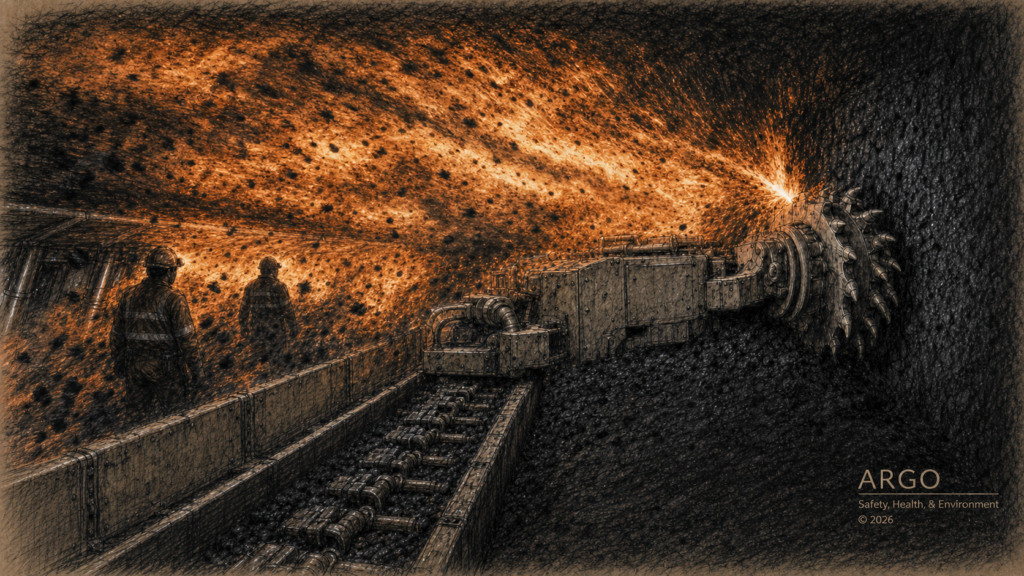
The initial ignition most likely occurred as a longwall shearer was cutting sandstone near the tailgate.
Two cutting bits on the shearer’s tail drum were badly worn and had lost their carbide tips. Contact with sandstone likely generated hot streaks capable of igniting methane.
The shearer’s water sprays should have cooled the cutting area and moved methane away from the cutting bits. Investigators found that seven sprays were missing from the tail drum. MSHA testing showed that this left the remaining sprays without effective water pressure.
The probable sequence was:
- Methane or natural gas accumulated near the longwall tailgate.
- Worn cutting bits contacting sandstone likely ignited the gas.
- The initial flame ignited a larger methane accumulation.
- The pressure wave suspended combustible coal dust.
- The coal dust propagated the explosion through the mine.
Coal dust did not merely make the original ignition larger. It became the fuel that transformed a localized event into a catastrophic explosion.
Properly applied rock dust—generally pulverized limestone—should have prevented the coal dust from sustaining the explosion. Investigators instead found extensive areas without sufficient incombustible material.
The Organizational Failure
The physical causes cannot be separated from how the mine was managed.
Upper Big Branch was operated by Performance Coal Company, a Massey Energy subsidiary. MSHA documented inadequate workplace examinations, uncorrected hazards, insufficient training, advance warning of inspections, inaccurate examination records, and practices that discouraged miners from reporting hazards or stopping production.
These were not isolated paperwork violations. Each failure weakened the mine’s ability to recognize and control risk.
The required safety systems existed. The organization failed to execute and verify them consistently.
A written program cannot protect workers when field conditions are reported inaccurately, maintenance problems become normalized, inspections are treated as obstacles, or production pressure prevents corrective action.
Accountability and Reform
After acquiring Massey Energy, Alpha Natural Resources entered into a $209 million agreement with the U.S. Department of Justice. The agreement included restitution for the families and injured miners, MSHA penalties, mine-safety improvements, and funding for safety research.
Former Massey Energy CEO Don Blankenship was later convicted of conspiring to willfully violate federal mine-safety standards. He was sentenced to one year in prison and fined $250,000. His conviction was for the safety-law conspiracy—not for directly causing the explosion.
The disaster also contributed to important regulatory changes. MSHA increased the required total incombustible content of mine dust to at least 80 percent in underground bituminous coal mines. The agency also revised inspection and rock-dust sampling practices and strengthened its approach to mines with serious or repeated violations.
Lessons for Every Executive
Upper Big Branch was a mining disaster, but its management lessons apply across high-risk industries.
Verify Critical Controls
Leaders should know which controls prevent catastrophic events and require evidence that those controls are functioning in the field.
Look at Failures Collectively
Missing water sprays, worn cutting bits, poor ventilation, and inadequate rock dust might appear to be separate deficiencies. Together, they created the conditions for disaster.
Protect Honest Reporting
Employees must be able to identify hazards and stop work without retaliation or pressure to protect production.
Watch for Organizational Warning Signs
Recurring violations, deferred maintenance, inaccurate records, advance notice of inspections, and normalized deviations are signs of a management-system failure—not simply individual mistakes.
Stop When a Critical Control Is Lost
If a control that prevents a catastrophic event is missing or ineffective, production must stop until the condition is corrected.
The ARGO SH&E Perspective
The hazards at Upper Big Branch were known, and the required controls were established. The failure was in maintaining those controls, verifying actual conditions, responding to warning signs, and creating an environment where safety concerns could influence operating decisions.
Catastrophic incidents rarely begin with one dramatic failure. More often, smaller deficiencies quietly align while the organization continues to operate.
ARGO Safety, Health & Environment Solutions helps leadership teams identify those vulnerabilities before they become part of an incident investigation. We evaluate critical controls, safety-management systems, field-verification practices, compliance processes, and organizational culture.
If your organization needs an independent assessment or practical help strengthening its safety systems, reach out to ARGO SH&E to schedule a consultation. The right time to find a weakness is before it becomes an emergency.