
The Dam That Failed on Its First Filling
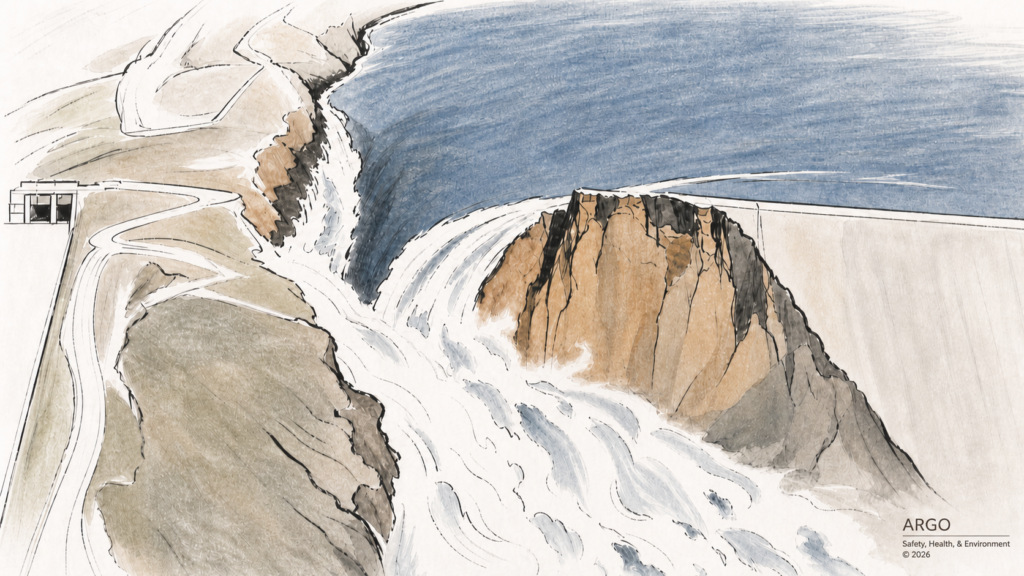
On June 5, 1976, the newly completed Teton Dam in southeastern Idaho failed while its reservoir was being filled for the first time. The collapse sent a massive flood through Wilford, Sugar City, Rexburg, and other downstream communities. Eleven people died, and losses were estimated at approximately $400 million at the time.
The disaster is often remembered as an engineering failure. It was also a leadership failure: known uncertainty was allowed to meet full operating pressure without enough defenses, monitoring, or ability to reverse course.
A Failure That Developed from Within
Teton Dam was a 305-foot-high earthfill structure. Its central core extended into a deep trench cut into jointed volcanic rock beneath the right side of the dam.
During the first filling, water found pathways through or along the right foundation area. The independent investigation concluded that the dam failed through internal erosion, commonly called piping. Water carried soil out from inside the dam. The hidden channel enlarged rapidly until the embankment could no longer contain the reservoir.
Early on June 5, workers observed significant seepage near the right abutment. The water soon became muddy—a critical sign that material was being eroded from within the structure. A sinkhole developed on the downstream face. Crews used bulldozers to push rock into the growing opening, but the erosion continued. Around noon, the crest collapsed and the reservoir broke through.
The investigation identified a combination of geological conditions and design choices. Open joints in the foundation rock had not been adequately sealed. The soil used in the key trench was vulnerable to cracking and erosion. The design depended heavily on the core, key trench, and grout curtain without adequate secondary defenses if those measures failed.
The Design Left Too Little Margin
The foundation rock contained open joints. The designers knew grouting would be required to reduce seepage, but the amount used exceeded the original estimate. Even then, post-failure testing found that water could still pass through parts of the grout curtain.
Compaction was also a legitimate construction concern. At steep, irregular foundation contacts, crews used loaded haul-truck wheels and power tampers. The investigation found that this “special compaction” required no enhanced moisture treatment; the soil remained slightly drier than optimum.
The design relied on that brittle soil remaining intact inside deep, narrow key trenches. Their geometry encouraged arching, cracking, and hydraulic fracturing. Once water reached a crack, the soil was highly erodible.
The dam therefore depended on two assumptions: that the grout curtain would adequately control seepage and that the compacted core would not crack. There were no adequate filters or drainage features in the key-trench area to safely control leakage if either assumption proved wrong.
That is the practical leadership lesson. When construction conditions consume far more grout, time, or material than anticipated, leaders should not treat the difference as a routine field adjustment. It may be evidence that a basic design assumption is wrong. Work should pause until the condition is understood, the design is independently re-evaluated, and adequate backup protection is provided.
Warning and Readiness Still Matter
Once Teton Dam began to fail, timely warnings and a rapid public response helped prevent an even greater loss of life. That does not excuse the failure. It shows the value of emergency planning when other controls no longer hold.
Effective preparedness requires more than a written plan. Warning systems must work. Leaders must know who can declare an emergency. Employees and communities must understand what action to take, and communication must be fast enough to matter.
The ARGO SH&E Perspective
Teton Dam is a reminder that startup pressure, schedule pressure, and unresolved technical uncertainty can combine into a catastrophic risk. Executives must insist on clear readiness criteria, independent review, effective monitoring, and a practical way to stop or reverse the operation before authorizing first use.
ARGO SH&E helps organizations evaluate critical risks, strengthen startup and emergency-readiness processes, and build clear accountability into everyday operations. If your organization is preparing for a major startup, expansion, or process change, contact ARGO SH&E to make sure the safeguards are ready before the pressure is applied.