
When Familiar Problems Stop Looking Dangerous
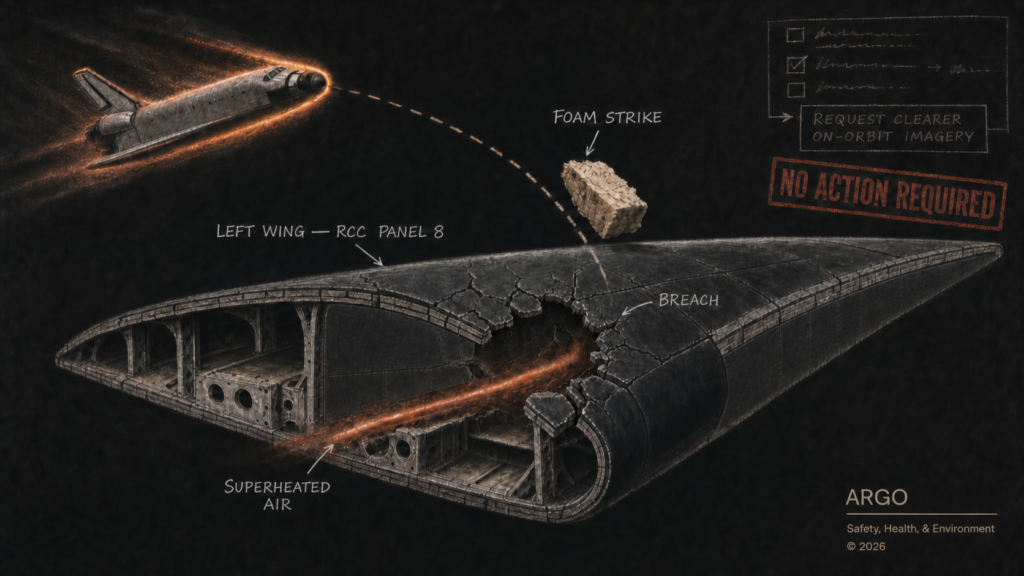
On February 1, 2003, Space Shuttle Columbia broke apart during reentry, killing all seven crew members. The physical cause began 16 days earlier, during launch, when insulating foam separated from the external tank and struck the leading edge of Columbia’s left wing.
The foam created a breach near Reinforced Carbon-Carbon panel 8. During reentry, superheated air entered the wing through that opening and progressively damaged its internal aluminum structure. The wing weakened, control was lost, and the orbiter broke apart over Texas.
The technical failure was catastrophic. The organizational failure had been developing for years.
A Warning That Had Become Familiar
Foam shedding was not new. Pieces had separated from external tanks on earlier shuttle missions, sometimes damaging heat-protection tiles. Because those events had not destroyed an orbiter, the condition gradually came to be viewed as an expected maintenance problem rather than a threat to flight.
That history shaped how managers interpreted the Columbia strike. Instead of asking what the unusually large impact might have done to the wing, they relied heavily on past experience: foam had struck orbiters before, and the missions had returned safely.
This is normalization of deviance. A condition falls outside the intended standard, but repeated exposure without a serious consequence makes it feel acceptable. The hazard has not become safer. The organization has simply become more comfortable with it.
Uncertainty Was Treated as Reassurance
Engineers recognized that the available launch images could not show the extent of the damage. They sought higher-resolution imagery of Columbia in orbit. The requests moved through an unclear chain of communication and were not acted upon.
The Columbia Accident Investigation Board found that management entered the mission already believing foam was not a safety-of-flight issue. Damage assessments relied on incomplete images, uncertain assumptions, tools used outside their validated range, and engineering judgment that was not fully communicated to mission leaders.
The burden of proof was effectively reversed. Engineers were expected to demonstrate that Columbia faced a serious danger without receiving the imagery needed to evaluate the wing. In a high-hazard operation, uncertainty about a critical protective system should increase concern—not close the discussion.
The Board concluded that NASA’s management practices were as much a cause of the accident as the foam itself. Communication barriers, schedule pressure, fragmented authority, and a weakened safety structure all contributed to a decision process that failed to pursue the unanswered question.
What Leaders Should Recognize
Columbia’s lesson applies far beyond aerospace. Organizations often learn to tolerate recurring leaks, alarms, equipment damage, temporary repairs, procedural exceptions, or near misses because the last occurrence did not cause a disaster.
Leaders should be especially cautious when they hear:
- “We have seen this before.”
- “It has never caused a serious problem.”
- “There is no evidence that it is unsafe.”
- “We can address it after the operation.”
Those statements may reflect experience, but they can also signal that abnormal conditions have become normalized.
Strong safety leadership changes the question. Instead of asking whether someone can prove the operation is unsafe, leaders ask whether the organization has enough reliable evidence to demonstrate that it is safe. They protect independent technical judgment, make uncertainty visible, and ensure that people can elevate concerns through a clear Stop Work Obligation.
The ARGO SH&E Perspective
Columbia reminds leaders that catastrophic events rarely begin with a completely unknown hazard. More often, warning signs are repeatedly explained away until the organization loses the ability to recognize what they mean.
ARGO SH&E helps organizations identify normalized risk, strengthen critical decision processes, and build safety systems that give leaders an honest view of operational exposure. If familiar problems are becoming accepted as part of the work, reach out to ARGO SH&E.