
When Safety Systems Exist Only on Paper
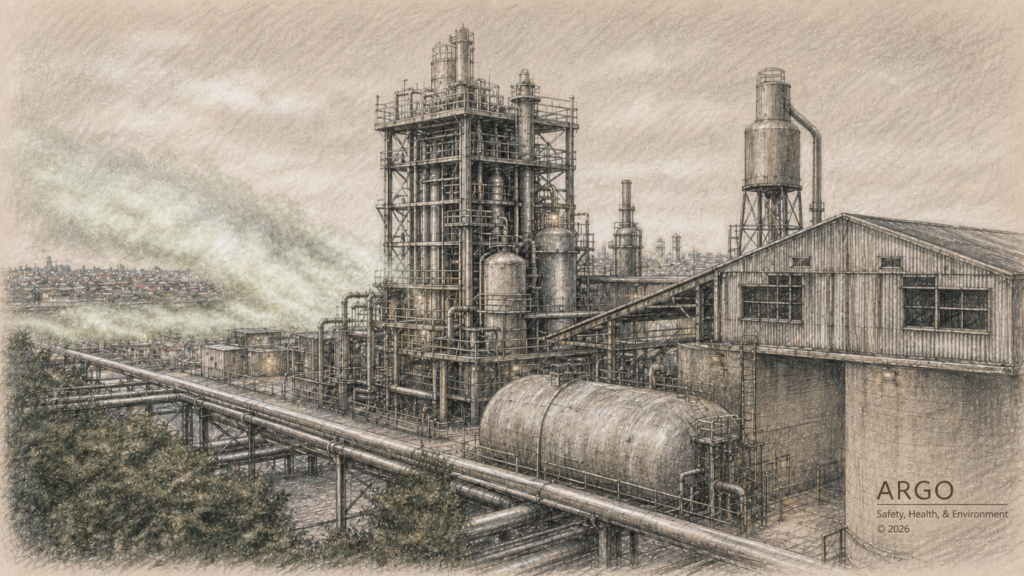
During the night of December 2–3, 1984, a runaway chemical reaction inside methyl isocyanate (MIC) storage Tank 610 at the Union Carbide India pesticide plant released a toxic cloud over Bhopal. The vapor moved beyond the plant and into nearby neighborhoods while people slept.
The World Health Organization has cited approximately 3,800 immediate deaths, 15,000 to 20,000 premature deaths in the following years, and more than 500,000 people exposed. The exact toll has been debated, but the scale of the disaster is not in question.
Bhopal’s central safety lesson is also clear: installing safeguards is not the same as keeping them ready.
What Happened
Water entered Tank 610 and reacted with the MIC. How the water entered became the subject of competing investigations and legal arguments. What followed is better established. The reaction generated intense heat and pressure until the tank’s relief valve opened.
A National Academies review reported that the valve remained open for about two hours and released more than 50,000 pounds of MIC as vapor and liquid. The material in the tank exceeded an estimated 200°C, and the vapor traveled close to the ground. MIC can severely injure the eyes and respiratory system, cause delayed lung damage, and be fatal when inhaled.
The reaction was the initiating event. The disaster grew because the layers intended to prevent or reduce a major release did not stop it.
Safeguards That Could Not Protect the Community
The MIC storage system depended on several protections. Refrigeration was intended to keep the chemical near 0°C and slow an unwanted reaction. A vent-gas scrubber was designed to neutralize MIC releases with caustic solution. A flare system provided another opportunity to destroy material before it reached the atmosphere.
On the night of the disaster, those protections were not fully available. The refrigeration system had been inoperative for nearly five months. The scrubber had been shut down. The flare system was undergoing maintenance. When Tank 610 began reacting, the facility was left without effective control of an escalating high-consequence event.
The off-site response was also inadequate. Nearby residents did not understand the hazard or receive the information needed to protect themselves. Hospitals were overwhelmed and initially lacked clear information about the chemical involved. Emergency preparedness failed at the point where the plant’s remaining defenses ended and the community’s survival depended on a fast, informed response.
What Leaders Should Learn
First, leaders must know which safeguards prevent their worst credible events. These are not ordinary maintenance items. Their condition should be visible to leadership, verified at defined intervals, and formally considered before operations continue.
Second, protection layers must be independent and ready at the same time. A scrubber, flare, alarm, backup tank, or emergency plan provides little protection when it is unavailable, undersized, poorly maintained, or dependent on another failed system.
Third, reduced production does not mean reduced risk. Hazardous inventory remains hazardous even when a process is idle. Shutdowns, staffing changes, deferred maintenance, and cost pressure can quietly weaken the systems needed most during an abnormal event.
Finally, emergency planning must extend beyond the fence line. Organizations handling highly hazardous chemicals need credible release scenarios, clear alarms, trained responders, current community coordination, and accurate hazard information ready for medical personnel.
These responsibilities belong to executive leadership. A program may look complete on paper while the actual operation has lost the ability to prevent or control a catastrophic release.
The ARGO SH&E Perspective
Bhopal shows why leaders must verify that critical safeguards work in practice—not merely confirm that they appear on a drawing, procedure, or inspection list. High-hazard operations require disciplined maintenance, clear operating limits, emergency readiness, and accountability when protection layers are unavailable.
ARGO SH&E helps organizations identify critical safeguards, evaluate process-safety gaps, strengthen emergency planning, and establish practical leadership oversight. If you want an experienced review of the systems protecting your workforce and community, contact ARGO SH&E.
Authoritative Sources
U.S. Environmental Protection Agency, Pressurized Storage Tanks: A Preliminary Assessment
World Health Organization, Manual for the Public Health Management of Chemical Incidents