
When Isolation Exists Only on Paper
On October 23, 1989, routine maintenance at the Phillips 66 Houston Chemical Complex in Pasadena, Texas, became one of the nation’s deadliest petrochemical disasters. Twenty-three workers were killed and more than 130 were injured.
The central lesson is straightforward: when people open process equipment, isolation must be physically dependable. A valve position, written procedure, or verbal assurance is not enough when one failure can expose workers to a live chemical process.
A Routine Task Becomes a Catastrophe
A contractor crew was clearing hardened polyethylene from a plugged settling leg connected to a reactor. Before the line was opened, plant operations personnel were supposed to isolate it from the reactor.
The work had already been completed successfully on another settling leg. That familiarity may have made the next job appear routine. It was not.
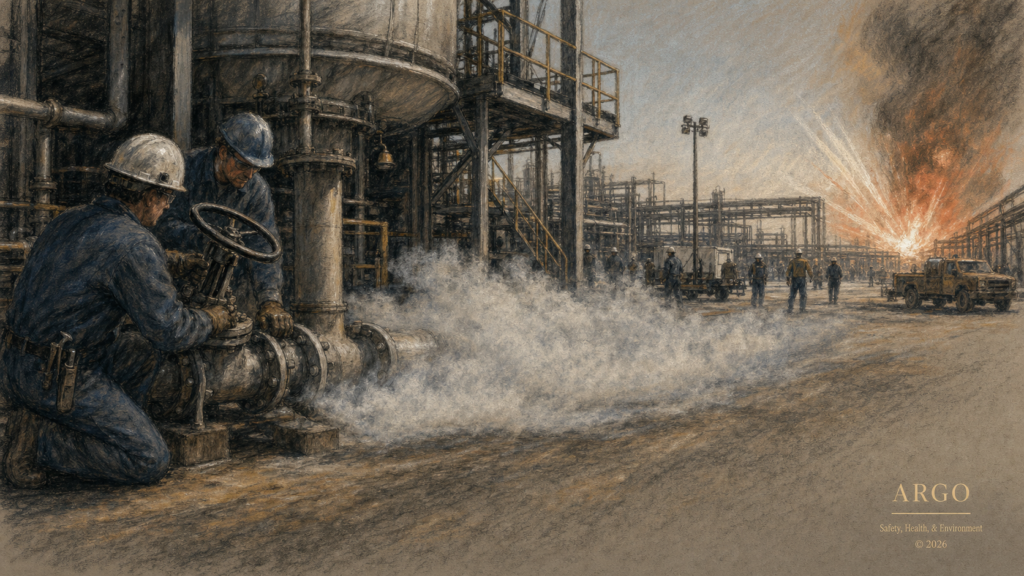
During work on the second leg, a valve between the open piping and the operating reactor was opened. OSHA’s investigation found that the pneumatic hoses controlling the valve actuator had been connected in reverse. In that configuration, the valve could open even when the actuator switch indicated that it was closed. The lockout system was not sufficient to prevent the valve from being opened during maintenance.
The operating reactor emptied almost its entire contents through the open line. Approximately 85,200 pounds of highly flammable gas escaped within seconds. A vapor cloud spread rapidly through the plant and reached an ignition source within roughly two minutes. The resulting explosion had the force of approximately 2.4 tons of TNT.
The Valve Was Not the Whole Failure
It would be easy to treat the reversed hoses as the cause and stop there. That would miss the larger lesson.
The maintenance crew was protected by a single valve on a pressurized process. There was no dependable secondary barrier, such as double block and bleed isolation or a physical blind. OSHA also identified inadequate lockout/tagout practices, an ineffective work-permit system, a lack of permanent combustible-gas detection in the reactor areas, and ignition sources near large hydrocarbon inventories.
The plant’s layout made the consequences worse. Occupied buildings and workers were too close to the process equipment. The control room was destroyed, and the people killed at the scene were found within 250 feet of the release point.
Most concerning, OSHA concluded that earlier reports from the company’s own safety personnel and outside consultants had identified unsafe conditions that were not adequately addressed. This was not simply an equipment malfunction. It was a management system that allowed known weaknesses to remain in place.
What Leaders Should Take From Pasadena
Executives do not need to understand every fitting in a process unit. They do need assurance that high-consequence maintenance is controlled by systems that cannot be defeated by one error.
That means requiring positive isolation before hazardous equipment is opened, clearly defining responsibilities between the host employer and contractors, and verifying conditions at the job site rather than relying only on paperwork. It also means tracking audit and hazard-review findings until corrective actions are complete and proven effective.
Leaders should pay particular attention to work described as routine. Repetition can create confidence without reducing the underlying hazard. If a task depends on a single valve, a single person, or a single indication being correct, the organization should ask what happens when that protection fails.
The ARGO SH&E Perspective
Catastrophic events often begin with ordinary work performed under weak controls. ARGO SH&E helps organizations strengthen process-safety systems, contractor coordination, hazardous-energy controls, work permits, and corrective-action accountability before those weaknesses align.
If you want an experienced, practical review of how high-hazard maintenance is planned and controlled in your organization, reach out to ARGO SH&E.