
When a Warning Comes Too Late
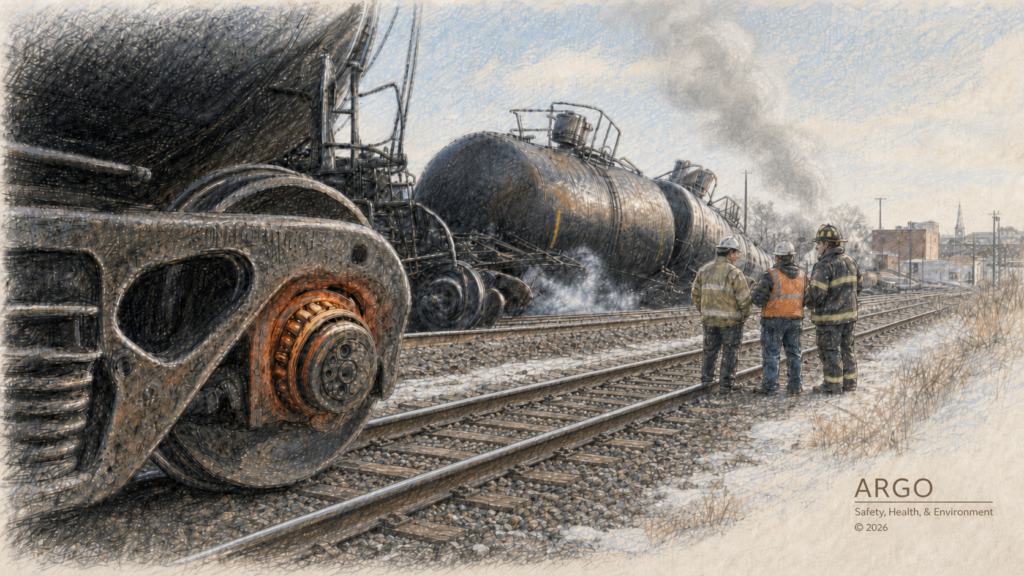
On February 3, 2023, a Norfolk Southern freight train derailed in East Palestine, Ohio. Thirty-eight railcars left the track, including 11 tank cars carrying hazardous materials. Fires followed, residents were evacuated, and a community became the center of a long and difficult environmental response.
The derailment began with the failure of a wheel bearing on a hopper car. That is a relatively small component in a very large system. But the larger lesson is not simply that a bearing failed. The warning system did not provide the train crew enough time to stop before the failure became a disaster.
For executives, East Palestine is a reminder that detecting a problem is not the same as controlling it. A warning has value only when it comes early enough, reaches the right people, and triggers a response that can still change the outcome.
A Developing Hazard
Railroads use trackside hot-bearing detectors to measure wheel-bearing temperatures as trains pass. The system is intended to identify overheating before a bearing fails.
The bearing involved at East Palestine was getting progressively hotter as the train traveled. However, the crew did not receive a critical warning until the train passed a detector in East Palestine. By then, the bearing was close to failure. The crew began slowing the train, but the axle failed and the derailment followed.
The National Transportation Safety Board found that detector spacing, operating procedures, and the difficulty of accurately measuring the bearing’s internal temperature prevented an effective warning in time to stop the train.
This is a familiar pattern in serious incidents. An organization may have inspections, alarms, procedures, and trained people, yet still remain exposed because the pieces do not work together soon enough. Leaders should not ask only, “Do we have a warning system?” They should ask, “How much useful response time does it give us under actual operating conditions?”
The Emergency Became More Complex
Three hazardous-material tank cars were mechanically breached during the derailment. Their contents ignited, and the fire exposed additional tank cars to heat. Five of those cars contained vinyl chloride.
Three days later, responders conducted a vent-and-burn operation. The cars were deliberately breached and the vinyl chloride was burned. The resulting plume became the defining public image of the disaster.
The NTSB later concluded that the vent and burn was not necessary to prevent a tank-car failure. Investigators found that the local incident commander’s decision was based on incomplete and misleading information supplied by Norfolk Southern officials and contractors. Other removal options had also been rejected.
This finding matters well beyond the railroad industry. During an emergency, the incident commander must be able to distinguish verified facts from assumptions, worst-case projections, and recommendations offered by parties with their own operational or financial interests. Technical experts should inform command decisions, but they should not control the information by presenting one course of action as inevitable.
What Leaders Should Do
Executives should test whether their critical safeguards create enough time for intervention. Alarm thresholds, inspection intervals, sensor placement, escalation rules, and shutdown procedures should be evaluated as one system—not as separate compliance activities.
Emergency plans also need clear rules for decision-quality information. Identify who has authority, what evidence is required, how uncertainty will be communicated, and when an independent technical opinion is necessary. Practice those expectations before an incident, when there is still time to resolve gaps.
Employees and contractors must also understand their Stop Work Obligation. When conditions are changing, information is incomplete, or safeguards are no longer reliable, stopping and reassessing may be the most responsible operational decision.
The ARGO SH&E Perspective
East Palestine shows how a developing equipment problem can outrun a warning system—and how poor information can compound the consequences after an incident begins. Effective SH&E leadership connects detection, escalation, emergency command, and executive oversight before the moment of crisis.
ARGO SH&E helps organizations evaluate those connections, strengthen emergency planning, and build practical systems that work under real operating conditions. If your safeguards or response plans have not been tested as a complete system, contact ARGO SH&E to start the conversation.