
Preparedness Has to Work Under Pressure
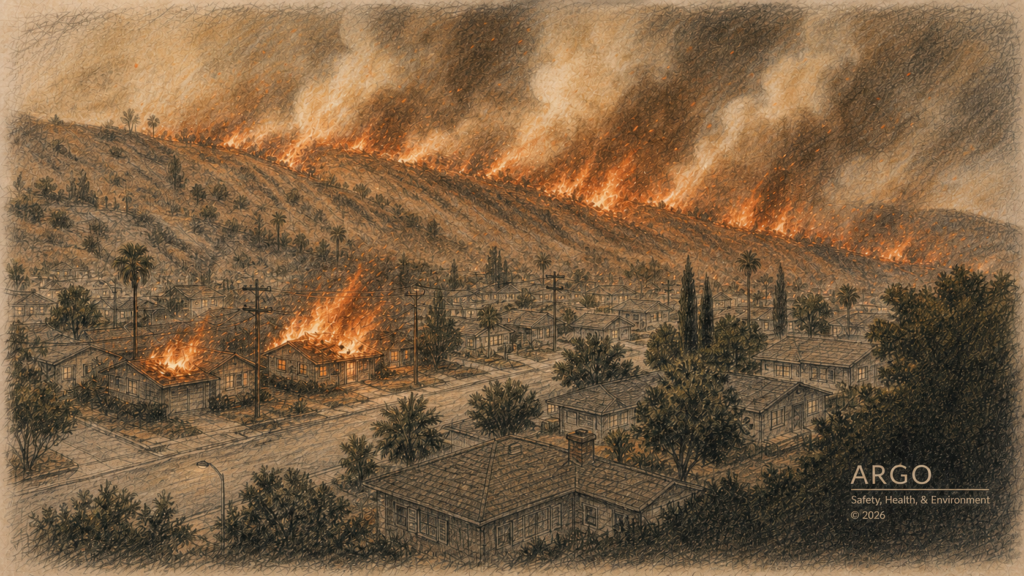
On January 7, 2025, extreme winds and dry conditions drove multiple wildfires across the Los Angeles region. The Palisades and Eaton fires became the most destructive. Together, they burned more than 37,000 acres, destroyed more than 16,000 structures, and claimed 31 lives.
Entire neighborhoods were devastated, businesses were displaced, utilities were disrupted, and thousands of people had to make urgent decisions with little time and incomplete information.
For business leaders, the central lesson is straightforward: an emergency plan is only useful if people can carry it out under pressure.
When Conditions Change Faster Than the Plan
The Palisades and Eaton fires were driven by hurricane-force winds that carried fire and embers into populated areas. Roads became congested. Power and communications were disrupted. Smoke affected communities well beyond the flames. Conditions changed by the minute.
Many emergency plans are written around an orderly event: an alarm sounds, employees follow a marked route, supervisors account for everyone, and normal communication systems remain available. A fast-moving wildfire may remove every one of those assumptions.
Leaders should test their plans against harder questions. What happens if the primary evacuation route is closed? Who can order a facility evacuation after normal business hours? How will the company account for field employees, contractors, visitors, or people working remotely? What if cellular service, electrical power, or the building itself is unavailable?
A plan that depends on one person, one route, or one communication method is not resilient.
Preparedness Must Be Operational
Effective wildfire readiness begins with clear decision points. Organizations should identify who monitors fire weather, evacuation notices, utility interruptions, and local air quality. They should also establish when operations will be modified, relocated, or suspended and who has authority to make those decisions.
Employees need simple instructions that can be followed without searching through a long manual. They should know how warnings will be communicated, where reliable information will come from, what they are expected to do, and how they will report their status.
Exercises should test realistic complications, not just familiar evacuation routes. A useful drill might assume that a road is blocked, a supervisor is unavailable, or the normal alert system has failed. The goal is not to predict every possible condition. It is to build an organization that can adapt when the expected plan no longer fits the event.
Smoke Is Also a Workplace Hazard
Wildfire risk does not end at the fire perimeter. Smoke can expose outdoor employees, drivers, construction crews, warehouse workers, and others working in areas without effective filtration.
California’s wildfire-smoke standard applies to many workplaces when the current Air Quality Index for fine particulate matter, or PM2.5, reaches 151 and employers should reasonably anticipate worker exposure. Covered employers must monitor conditions, communicate the hazard, train employees, and reduce exposure through measures such as filtered air, relocation, schedule changes, reduced work intensity, and appropriate respiratory protection.
Even outside California, the operating principle is sound: decide in advance who will monitor air quality and what actions each threshold will trigger. Do not wait until employees are already working in heavy smoke to determine the response.
Continuity Starts With People
Business continuity is often treated as an information-technology or insurance exercise. Those elements matter, but continuity begins with people.
Organizations should identify critical functions, alternate work locations, backup suppliers, essential records, and recovery priorities. They should also consider how employees will be supported when they are evacuating their families, losing access to transportation, or dealing with damage to their homes.
The strongest continuity plans recognize that workforce safety and operational recovery are not separate goals. One depends on the other.
The ARGO SH&E Perspective
The 2025 Los Angeles wildfires showed how quickly extreme conditions can overwhelm normal systems. Leaders cannot control the wind or the fire, but they can build clear decisions, reliable communications, practiced alternatives, and practical protections before an emergency begins.
ARGO Safety, Health & Environment Solutions helps organizations assess emergency risks and develop response and continuity programs that work in real operating conditions. If your organization needs to strengthen its emergency preparedness, contact ARGO SH&E to get started.