
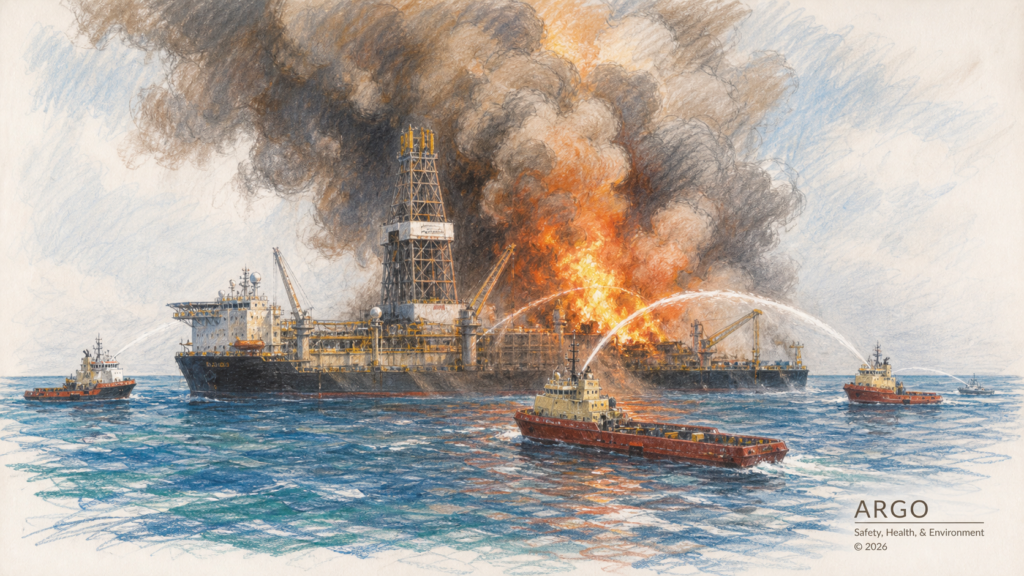
When Multiple Barriers Fail
On April 20, 2010, the Deepwater Horizon mobile offshore drilling unit suffered a blowout while completing BP’s Macondo well approximately 40 miles off the Louisiana coast. Hydrocarbons reached the rig, ignited, and caused explosions and a fire that killed 11 workers and injured 17. The vessel sank two days later.
Oil then flowed from the damaged well nearly a mile below the surface for 87 days. NOAA estimates that 134 million gallons entered the Gulf, making it the largest marine oil spill in U.S. history.
The scale of the environmental damage was extraordinary. But the event’s most important safety lesson is not its size. It is the number of opportunities that existed to prevent it.
What Went Wrong
The federal investigations identified many technical and organizational failures. For leaders, they can be reduced to three root causes:
- The well was not secure. The cement barrier intended to keep oil and gas inside the formation failed. The operation then depended on the remaining safeguards to recognize and control the danger.
- A failed test was accepted as a passing test. Pressure returned repeatedly during the negative-pressure test. Instead of treating the conflicting readings as evidence that the well was unsafe, the team accepted an explanation that allowed the work to continue.
- The response came too late. Oil and gas entered the well and moved toward the vessel without being controlled soon enough. When the emergency systems were finally needed, the blowout preventer did not seal the well.
What Leaders Should Learn
Each root cause points to a practical leadership responsibility.
First, leaders must know which safeguards prevent their worst credible events and verify that those safeguards are working. Injury rates and general compliance activity do not provide that assurance. The U.S. Chemical Safety Board found that BP and Transocean emphasized personal-safety measures without giving equal attention to the barriers intended to prevent a major accident.
Second, critical tests need firm pass-or-fail criteria. Everyone involved should know what success looks like, who can interpret the results, and what must happen when readings conflict. Ambiguity is a reason to stop and investigate—not permission to proceed.
Third, warning signs must trigger action while the problem is still controllable. Employees need the training, information, and leadership support to exercise their Stop Work Obligation. Schedule pressure must never lower the standard for continuing an operation.
These lessons apply well beyond offshore drilling. Chemical processing, manufacturing, mining, construction, utilities, and transportation all rely on effective barriers, disciplined decisions, and an early response when conditions move outside the plan.
The ARGO SH&E Perspective
Deepwater Horizon demonstrates the danger of treating warnings as problems to explain rather than signals to investigate. Effective SH&E leadership makes critical barriers visible, establishes firm decision points, and supports people who stop work when conditions fall outside the plan.
ARGO SH&E helps organizations strengthen risk assessments, operating procedures, critical-control programs, and leadership accountability. If you want a practical review of the safeguards protecting your operation, contact ARGO SH&E.
Authoritative Sources
NOAA, “What happened during the Deepwater Horizon oil spill?”
U.S. Chemical Safety Board, Macondo Investigation Report, Volume 3
BSEE and U.S. Coast Guard Joint Investigation Team, final-report summary